Designing for Trust: Building a Patient-Centered Digital Health Experience at knownwell
knownwell is a mission driven obesity medicine company delivering in-person and virtual care. We built a patient-facing digital experience from the ground up for an audience that had frequently been dismissed, ignored, or actively shamed by the healthcare system.
My role: Head of Design, leading all patient-facing product design across web and native mobile (iOS and Android), product strategy, brand and user research.
Results:
• Patient experience satisfaction: 4.2 star rating on iOS, 4.3 star rating on Android, 91.7 NPS
• Registration funnel with a 15.4% conversion rate, well above the industry average
• ~9,000 Average patient visits per month with 85.5% of patients adhering to recommended visit cadence
• 9.81K MAU on the patient app
• Patient experience satisfaction: 4.2 star rating on iOS, 4.3 star rating on Android, 91.7 NPS
• Registration funnel with a 15.4% conversion rate, well above the industry average
• ~9,000 Average patient visits per month with 85.5% of patients adhering to recommended visit cadence
• 9.81K MAU on the patient app
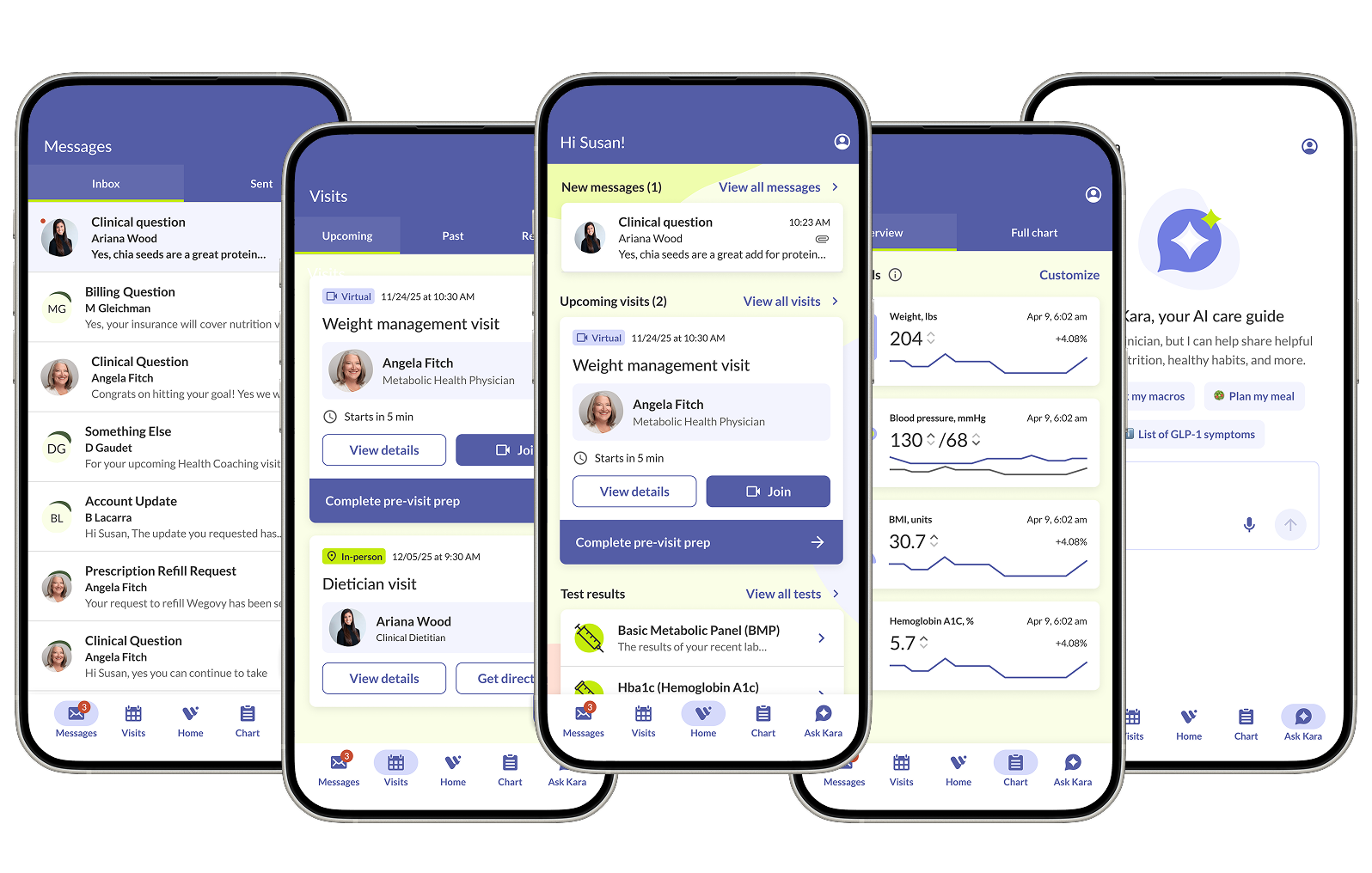
The product challenge wasn't just usability. It was patient trust. And that trust had to be built into every layer of the product: interaction design, visual design, UX copy, and research practice.
Trust is built throughout the experience by following a strategic framework:
• Consistency: Every touchpoint — visual, verbal, functional — reinforced the same message to the patient: you belong here.
• Empathy: Designing for the emotional state of the user, not just their task state.
• Agency: Giving users control to choose, decide and move at their own pace.
• Consistency: Every touchpoint — visual, verbal, functional — reinforced the same message to the patient: you belong here.
• Empathy: Designing for the emotional state of the user, not just their task state.
• Agency: Giving users control to choose, decide and move at their own pace.
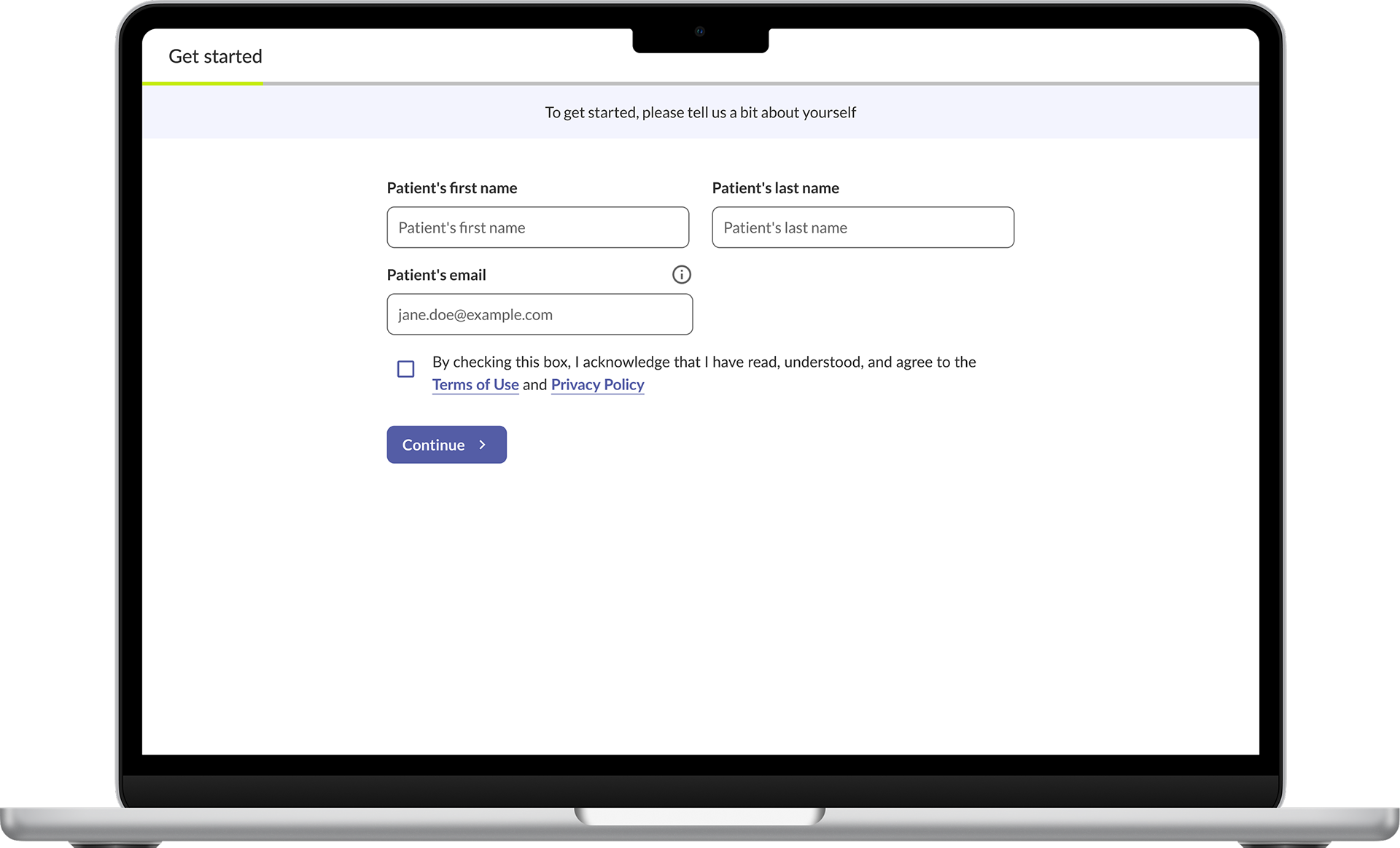
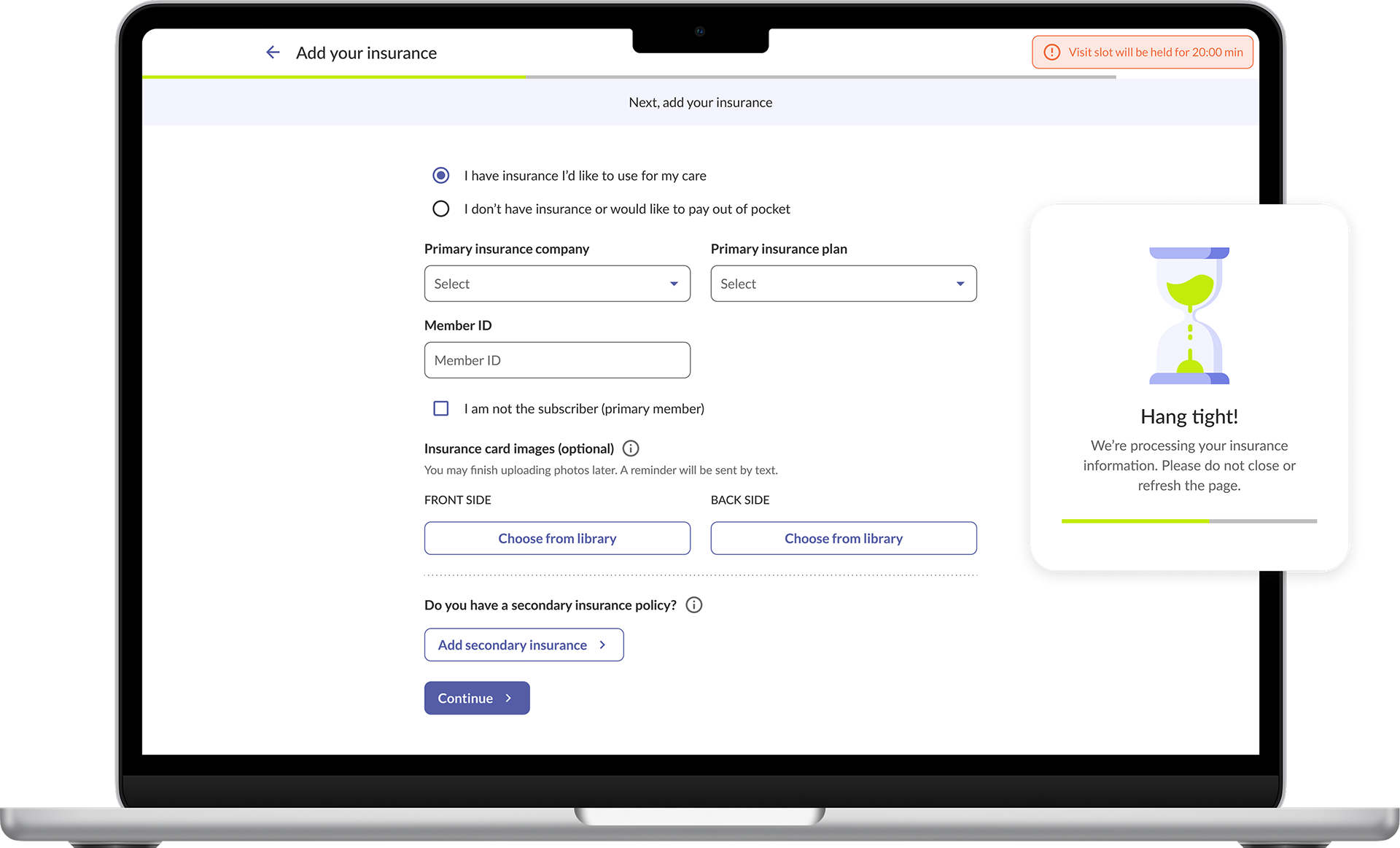
Registration: The First Click as a Trust Signal
Challenge: Traditional healthcare registration flows are long, clinical, and anxiety-inducing. For our patient population, this was often the first digital interaction with any healthcare brand after years of negative experiences.
Strategy: Redesigned the entire registration experience around one principle — the first click should be the first step of feeling seen. Digital registration allows patients to easily start their care at knownwell while also gathering the personal information necessary for their clinical care. Information not needed to complete first visit registration, such as the full patient medical chart and medication list is gathered primarily through tools and automations prior to the first visit.
Key decisions:
• Simplified the experience to collect only the personal information needed to get a patient booked for their first visit.
• Built in real-time insurance eligibility checks and insurance card capture so patients know their care is covered before they arrive.
• Moved visit slot selection into the middle of the flow, so patients book a specific visit with a specific clinician before encountering any paperwork. This reframed the emotional arc: you're securing your care, then completing the details.
• Added clinician photos to booking to build emotional connection before the first visit.
Results:• 17k+ patients booked through the redesigned flow
• Average registration time: 10 minutes
• Registration funnel conversion of 15.4%
• 10.7k patients self-scheduled their new patient visit (Q1-2 2026)
• Visit no-show rate: 4.3% (well below industry benchmarks)
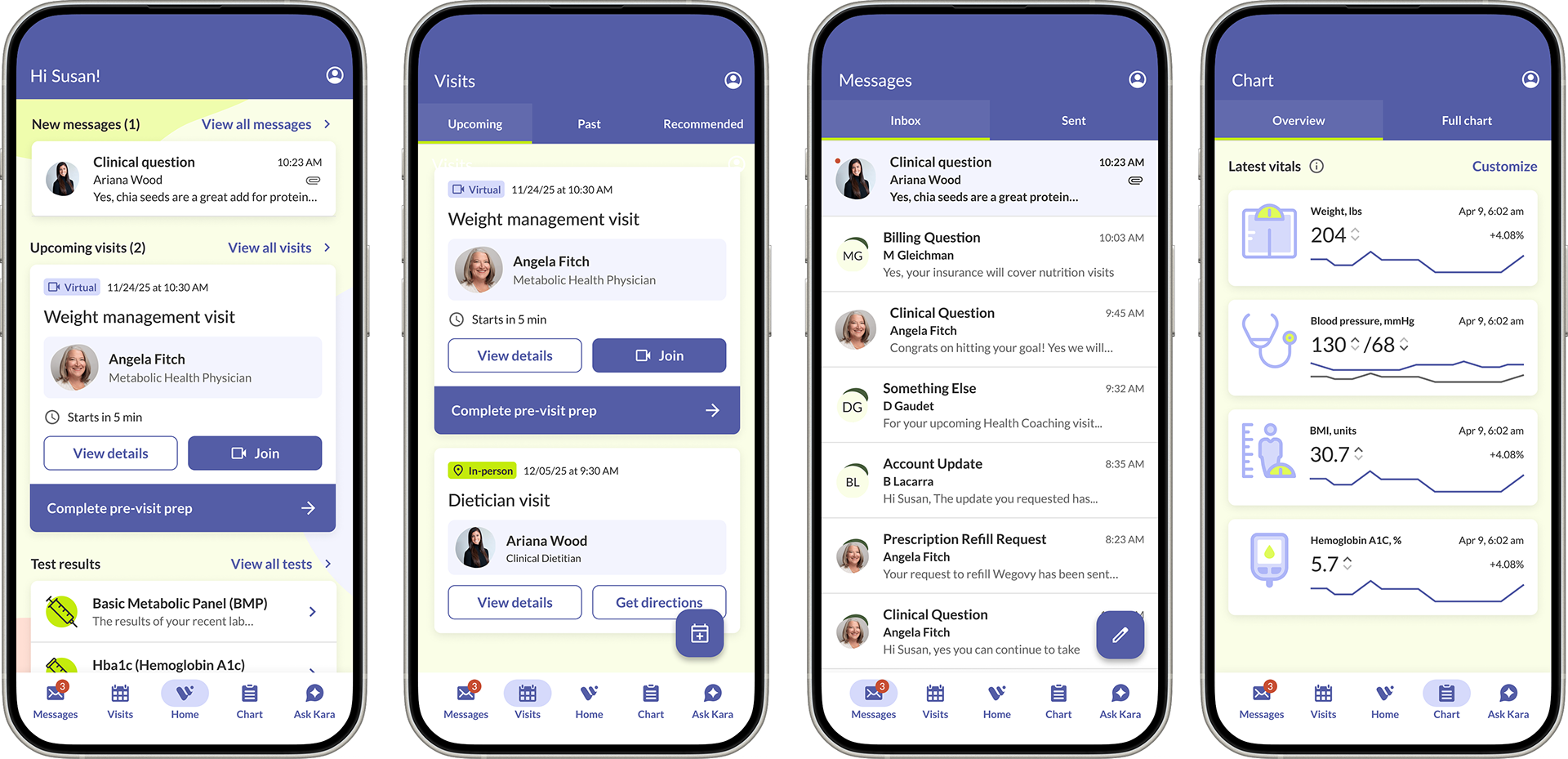
Patient App: Agency as a Product Feature
Challenge: Build a patient experience that gives them meaningful control over their care — across scheduling, communication, clinical data, and engagement — while maintaining the warmth of an in-person visit.
Strategy: Launched a native iOS, Android, and web app in April 2025 with agency as the core design goal. Every feature balances patient control of their care with clinical guidelines and workflows.
knownwell patient app is custom built experience for our patient population that is integrated with athenahealth EHR tool on the back end. This allows clinical team members to only interact within the EHR, while patients have an experience tailored to their needs at knownwell.
knownwell patient app is custom built experience for our patient population that is integrated with athenahealth EHR tool on the back end. This allows clinical team members to only interact within the EHR, while patients have an experience tailored to their needs at knownwell.
Key decisions:
• Designed customizable vitals views where patients can choose to hide weight and BMI in their chart, recognizing that these metrics are psychologically loaded for our population.
• Designed secure clinician messaging, upcoming visit management, joining virtual visits, access to full medical chart with educational materials and vitals progress tracking as a cohesive experience that mirrors the welcome of knownwell's physical clinics.
Results:
• 80–90% app adoption among patients seen in the last 30 days, with some markets exceeding 90%
• 9.81K MAU in the patient app
• ~23,000 app sessions per month
• 14 page views per session
• Average 14K message threads per month
• ~9,000 Average patient visits per month with 85.5% of patients adhering to recommended visit cadence
• 11k patient weight readings were uploaded via app
• 80–90% app adoption among patients seen in the last 30 days, with some markets exceeding 90%
• 9.81K MAU in the patient app
• ~23,000 app sessions per month
• 14 page views per session
• Average 14K message threads per month
• ~9,000 Average patient visits per month with 85.5% of patients adhering to recommended visit cadence
• 11k patient weight readings were uploaded via app
Self-Scheduling Drives Care Plan Adherence
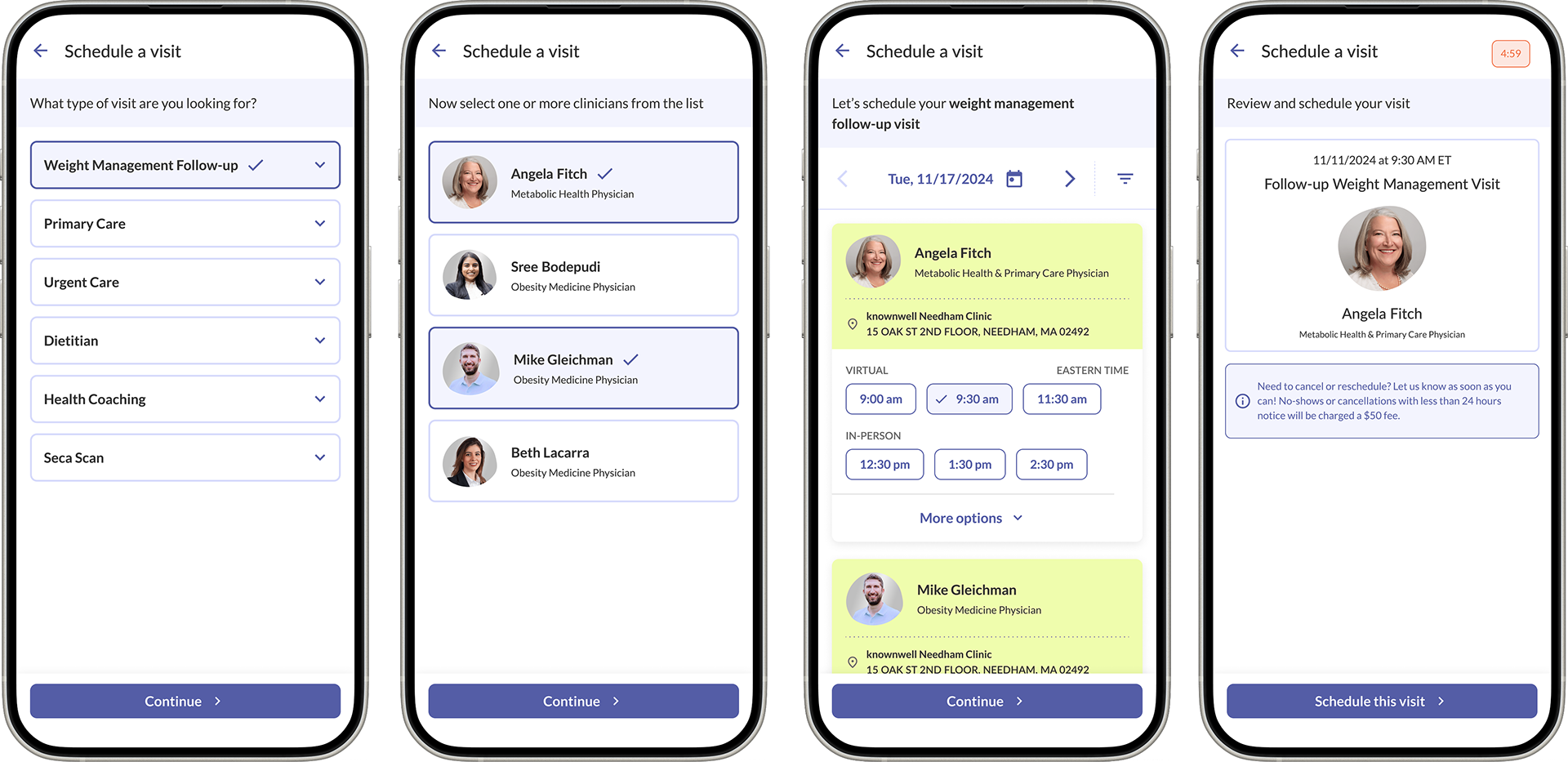
Challenge: Build a scheduling structure that can support multiple visit types over time and scale across growing markets, allowing patients to book with their desired clinician and format (virtual or in-person).
Strategy: Reduce inbound phone calls from patients for scheduling, freeing up lines for clinical urgent care. Allow patients the convenience of scheduling from the patient app in order to drive visit cadence adherence which has been shown to improve health outcomes.
Flexible UX structure allows for 2 paths for scheduling:
1. Patients schedule specific visit types within a time frame suggested by their clinicians in order to adhere to desired visit cadence to support their health outcomes. For example, patients on a GLP-1 are recommended to have a visit every month for the first 6 months.
2. "Choose your own adventure" visit type selection gives patients control over the kind of care they seek, not just the time slots. This encourages patients to book new types of care with knownwell including Dietitian or Health Coaching visits.
Results:
• 7.8k follow-up weight management visits self-scheduled through the app
• 5.2k visits rescheduled in-app
• 6.5k reasons for visit added by patient in-app
• 7.8k follow-up weight management visits self-scheduled through the app
• 5.2k visits rescheduled in-app
• 6.5k reasons for visit added by patient in-app
Pre-visit Patient Prep
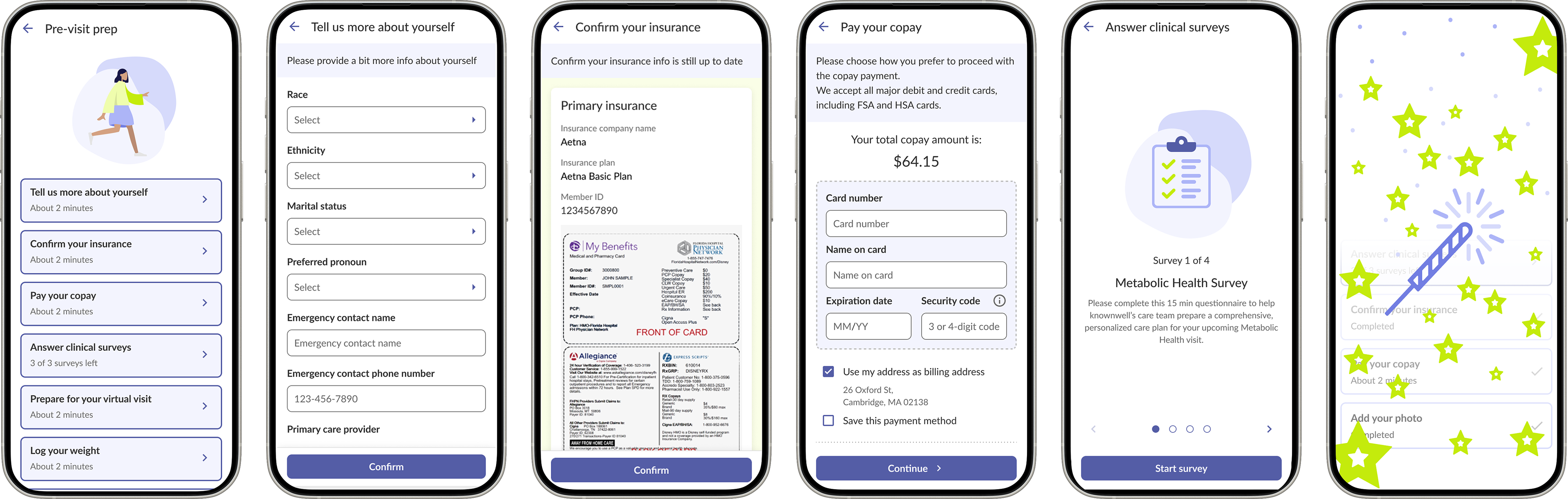
Challenge: Before a patient visit, we have an opportunity to gather or confirm information in order to give patients the highest quality of personalized clinical care. This flow also serves as a business opportunity to confirm insurance and payment before the visit,
Strategy: Pre-visit content is personalized to the patient visit type and information we have already gathered from the patient. A modular guided flow can scale with the patient visit needs without overwhelming the patient in the moment.
Pre-visit guided content:
• Additional demographic information is collected such as preferred pronouns, pharmacy and primary care provider, which were not critical to registration
• Insurance confirmation or self-pay and co-pay payments allow prior authorization teams to confirm patient coverage (especially for GLP-1s) and gives patients cost transparency
• Clinical surveys customized to patient visit type allow clinicians to prepare personalized care plans
• For virtual visits, patients allow microphone and camera access to reduce technical challenges during the visit
• Completion screen animation adds surprise and delight for the user
• Additional demographic information is collected such as preferred pronouns, pharmacy and primary care provider, which were not critical to registration
• Insurance confirmation or self-pay and co-pay payments allow prior authorization teams to confirm patient coverage (especially for GLP-1s) and gives patients cost transparency
• Clinical surveys customized to patient visit type allow clinicians to prepare personalized care plans
• For virtual visits, patients allow microphone and camera access to reduce technical challenges during the visit
• Completion screen animation adds surprise and delight for the user
Results: (Q1-Q2 2026, Launched Q1)
• Almost 17k pre-visit prep app sessions
• Over 9k unique patients did pre-visit prep at least once
• Almost 17k pre-visit prep app sessions
• Over 9k unique patients did pre-visit prep at least once
AI chat: Designing for a New Trust Relationship
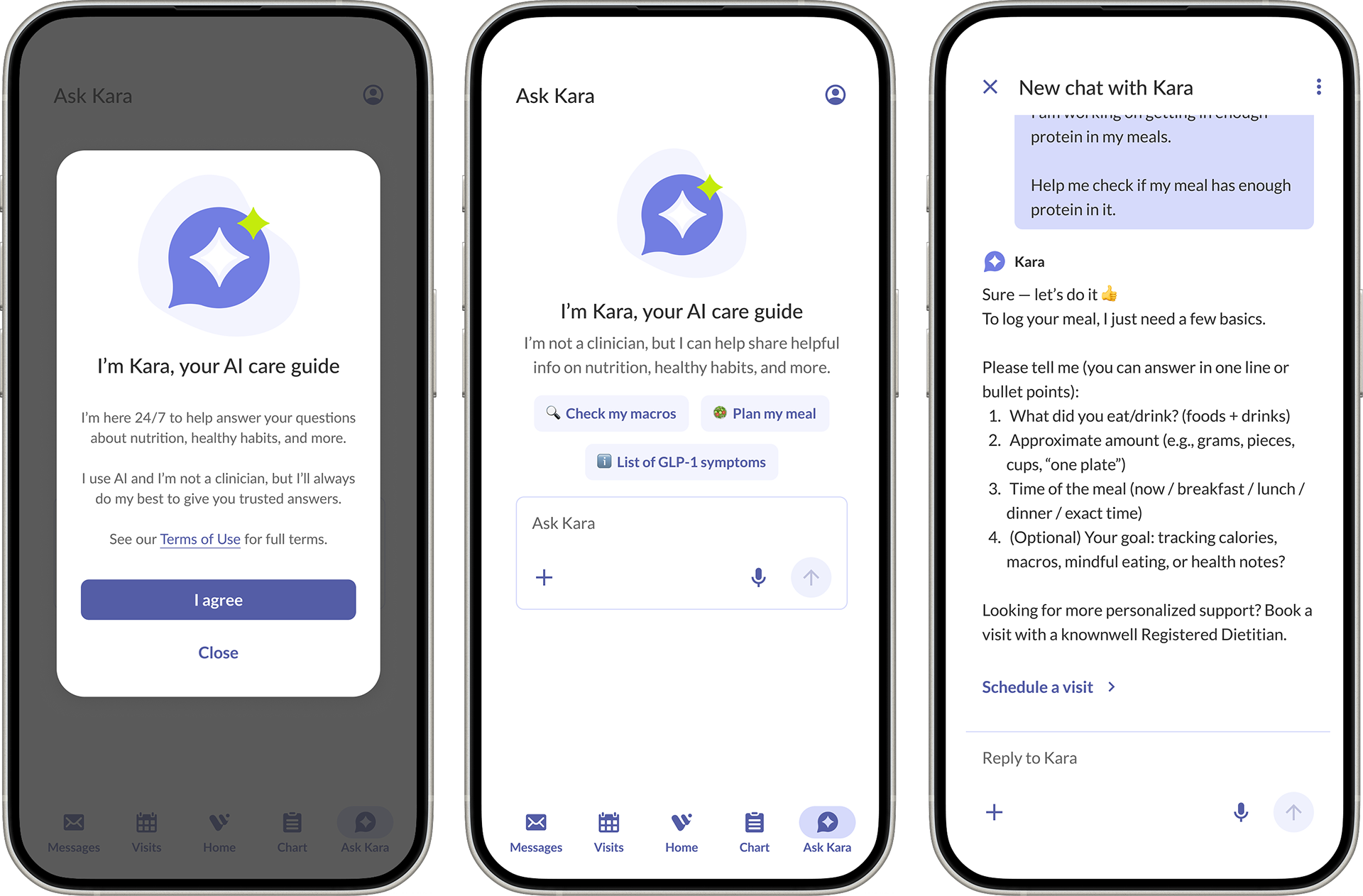
Challenge: Kara, an AI care agent integrated into the patient app, supports patients in between clinical visits. To reduce clinician message inbox volume and increase patient engagement, Kara supports 24/7 education nutrition, lifestyle habits and GLP-1 symptom support. Kara's agent is trained on knownwell clinical material so that she will give patients consistent care to what they receive from in-person interactions. The agent also has several guardrails built in for patient safety and brand language consistency.
The core design problem: When a patient gets a message from a care team member, they have a clear mental model. When an AI agent responds to a clinical question, that model breaks down, and for patients who already arrived with distrust, an opaque AI interaction can feel like exactly the kind of dismissal they've experienced before.
Key decisions:
• Transparency without anxiety: Designed the AI disclosure to feel welcoming rather than alarming. "I'm Kara, your AI care guide" communicates whose side the technology is on and makes the patient feel at ease when interacting with Kara.
• Voice consistency: Kara's tone is trained to match knownwell's brand voice: conversational, empowering, stigma-free, to create a consistency between the human experience and the AI experience.
• Human handoff design: Defined the criteria and interaction patterns for when Kara recognizes the need to escalate to a human clinician, making the handoff feel seamless and caring, not like the AI gave up. Based on content guardrails, patients are also directed to additional support such as messaging in app or booking a visit with their clinician.
• Surprise and delight: To add delight to engagement with Kara, users receive haptic feedback when Kara replies in a chat feed and a short animation to the iconography when first opening the feature page.
• Clinical and safety guardrails: To protect patients and ensure they receive clinically correct information, Kara chat agent is built with multiple agent prompt guardrails that work together.
Results: Kara is planned to launch Summer 2026• Surprise and delight: To add delight to engagement with Kara, users receive haptic feedback when Kara replies in a chat feed and a short animation to the iconography when first opening the feature page.
• Clinical and safety guardrails: To protect patients and ensure they receive clinically correct information, Kara chat agent is built with multiple agent prompt guardrails that work together.